


Residential Complex in Kifisia
Residential Complex in Kifisia
A contemporary architectural approach to the urban landscape and living
How do you design within an urban environment like Kifisia?
A well-established residential area defined by its strong presence of greenery, generous private gardens, and a historically shaped identity of living, where architecture negotiates a delicate balance between the city and the landscape.
The residential complex is conceived as a contemporary architectural proposal that integrates into its urban context without competing with it. Through a clear and cohesive identity, it contributes to the continuity and subtle evolution of the area’s character.
The composition draws from the distinct qualities of Kifisia, bringing together urbanity and natural elements into a unified system, where built form and greenery coexist in an ongoing dialogue with everyday life.
Architectural composition & materiality
The architectural identity of the project is defined by a layered composition of volumes, articulated through a strong horizontal order. Projecting slabs and the stepped arrangement of volumes generate a sequence of conditions between light and shadow, exposure and protection, while horizontal lines extend into the urban field, reinforcing continuity with the surrounding environment and allowing the building to be read as part of the city.
Between the volumes, a network of intermediate outdoor and semi-outdoor spaces emerges, structuring transitions and establishing a clear spatial hierarchy. These spaces act as filters, enhancing depth and gradation, while greenery is actively integrated through planted areas, courtyards, and elevated surfaces, becoming an intrinsic part of the architectural composition.
Materiality reinforces this approach. The use of natural materials contributes to a seamless integration with the surroundings, while the clarity of geometry and construction expresses a contemporary and refined architectural language.
Living experience
Living is approached through clarity of organization and functional coherence. The arrangement of spatial units ensures usability and flexibility, responding to contemporary patterns of inhabitation.
Outdoor spaces are not treated as secondary elements, but as active extensions of everyday life, supporting a range of activities and expanding the experience of the home beyond its interior boundaries.
Internally, the spatial organization is defined by clear lines and a subtle hierarchy, enhancing comfort, ergonomics, and an overall sense of continuity.
Interior design
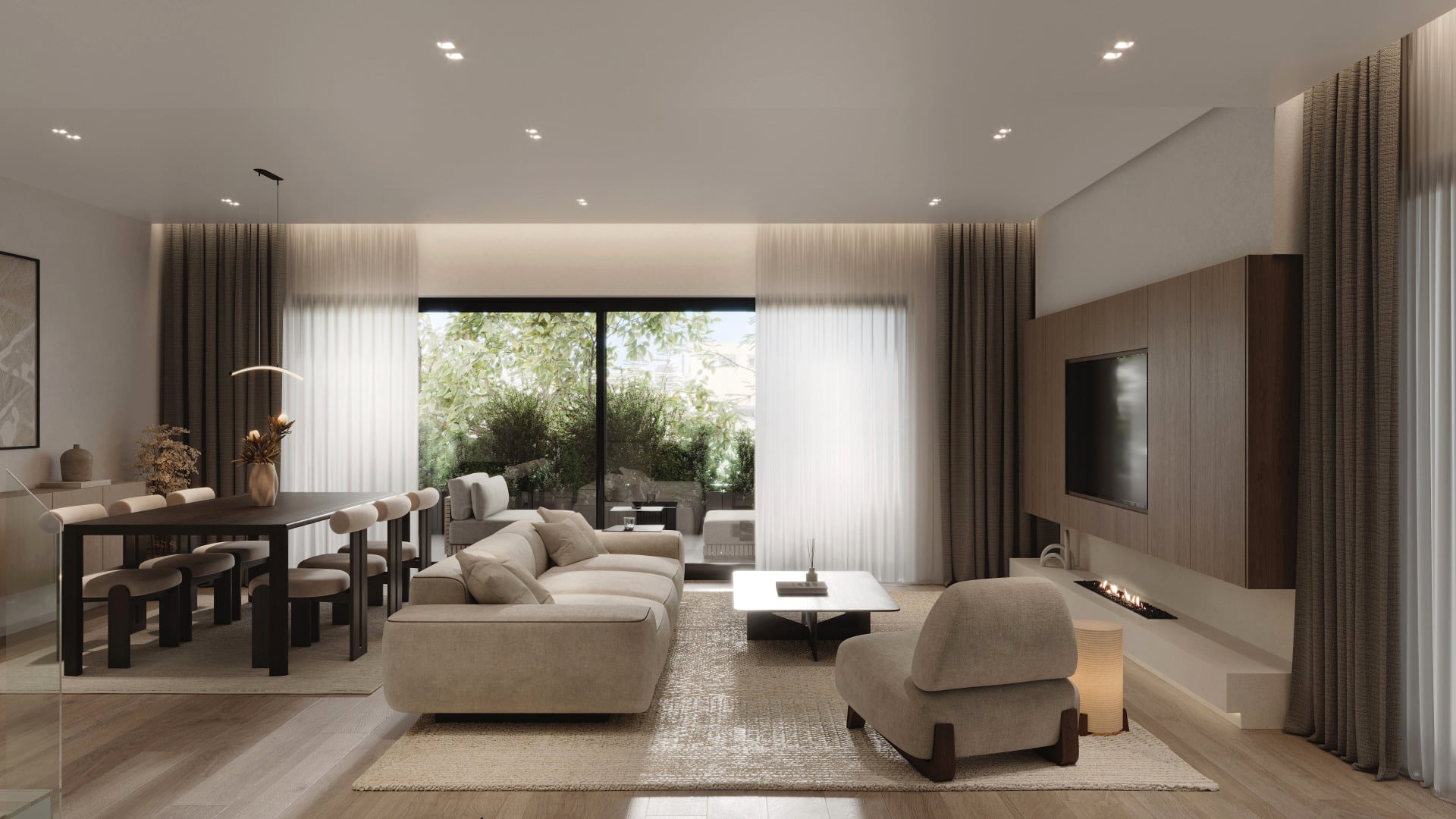
The interior design focuses on creating a cohesive and timeless environment. Material selection emphasizes natural qualities and durability, while the palette remains restrained, allowing textures and surface clarity to define the character of the spaces.
Light is carefully orchestrated to shape a calm and balanced atmosphere, avoiding unnecessary contrasts and supporting an approach that prioritizes long-term spatial quality over momentary effect.
Architecture in dialogue with the city
The residential complex is conceived as an architectural intervention that engages with its urban context, responding to the scale and structure of the surrounding area.
Through the clear organization of volumes and the integration of greenery, the project becomes organically embedded within the urban fabric, maintaining a balance between the built and the natural, while contributing to the subtle transformation of the local identity.
It is an architecture that operates as part of the city, reinforcing the coherence of the urban environment and negotiating a balance between a contemporary expression and the enduring character of Kifisia.